
 Facebook
 X
X
 Pinterest
 Copy Link
Late summer usually brings a quieter stretch in Denver real estate — the run from early August through Labor Day has traditionally meant fewer showings and a slower pace all around. This year, the numbers back that up, but not in the way a quick headline might suggest. Closings dropped sharply in August, yet prices and days on market barely moved. That combination tells a more interesting story than “the market is up” or “the market is down,” and I want to walk through what it actually means depending on where you’re standing right now.
Market Overview – August 2026:
- Median Sale Price: $594,495 — down 1.74% from July, essentially unchanged from a year ago (up 0.25%)
- New Listings: 4,893 — down 10.20% from July, up 4.46% from last August
- Days in MLS (Median): 27 — up from 21 in July, though still faster than last August’s 30
- Close-Price-to-List-Price Ratio: 98.54% — down slightly from July’s 98.98%, essentially flat year-over-year
Current Conditions
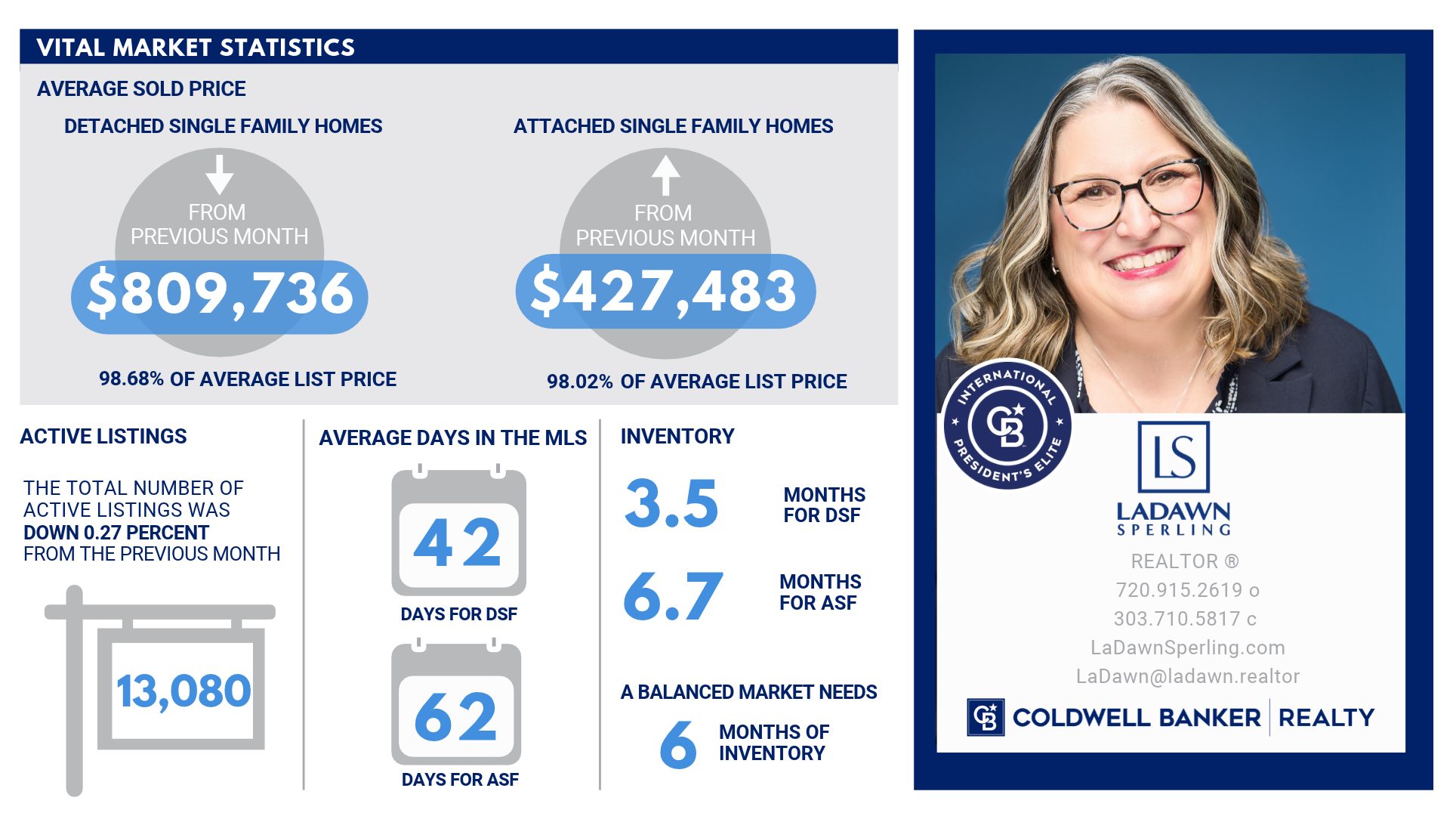
Inventory held remarkably steady. Active listings ended the month at 13,080 — down just 0.27% from July and up only 0.16% from a year ago. After peaking in July, inventory eased slightly in August, which looks like a normal seasonal pattern rather than the start of a bigger shift. What changed was transaction volume: closed sales fell nearly 19% from July and 17% from last August. That’s a market doing fewer deals, not a market where homes are suddenly worth less.
Buyer behavior has been a bit of a surprise for this time of year. Showing activity and offer counts have reportedly picked up on well-priced homes even as we head into the historically slower late-summer stretch — the kind of momentum we’d normally expect to see back in spring. Sellers, meanwhile, are experiencing two very different markets depending on what they’re selling. Detached home inventory actually shrank 4.21% year-over-year, while attached inventory (condos and townhomes) grew nearly 10%. That divergence means detached sellers are facing less competition than attached sellers right now, and it’s showing up in price trends too — detached prices have held essentially flat over the past year, while attached prices are down almost 5%.
Taken together, this reads as a neutral, balanced market overall — but one where the experience varies a lot by property type. It isn’t accurate to call this a buyer’s market or a seller’s market across the board; it depends on what you’re buying or selling.
For Sellers
With the close-to-list ratio sitting at 98.54%, there isn’t much room left for pricing above what buyers are willing to pay — accurate pricing from day one still matters more than a number you hope the market will grow into. This is especially true if you’re selling a condo or townhome, where rising inventory means more competition for buyer attention. Strong presentation and preparation aren’t optional extras right now; they’re what separates a home that sells quickly from one that sits.
For Buyers
Inventory is sitting near its highest point of the year, which means real choices rather than a handful of homes to choose from. Days on market crept up to 27, giving you a little more breathing room to make a thoughtful decision instead of a rushed one. If you’ve been waiting for the “right moment” to jump in, the data suggests this stretch offers more room to negotiate and less pressure than what we typically see in spring — strategy matters more here than perfect timing.
Looking Ahead
Keep an eye on whether the buyer momentum we saw in August carries into the fall — some of the activity that usually shows up earlier in the year appears to be arriving later this season. I’ll also be watching whether the gap between detached and attached performance continues to widen, since that has real implications for pricing strategy depending on what you own or want to buy. Nothing in this data points to instability; it points to a market that’s settling into a steadier, if more segmented, rhythm.
Need Help Navigating This Market?
Whether you’re thinking about buying, selling, or just trying to understand what this market means for your next chapter, I’d love to have a conversation. Making good things happen for good people is what I do — let’s figure out what’s next for you.
